“Most Nobly Has He Redeemed His Pledge”
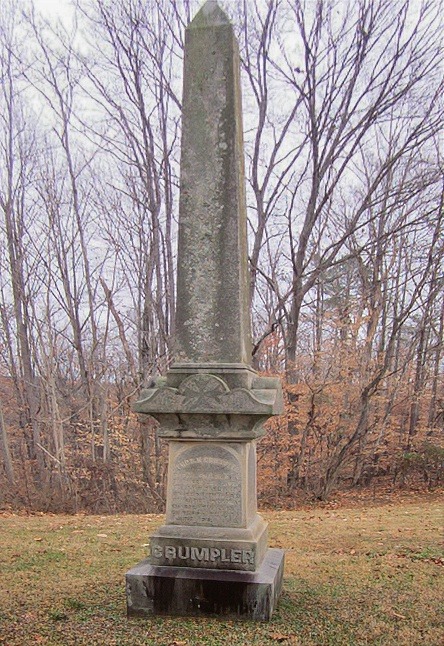
On a summer day in 1887 a crowd of fifteen hundred or more gathered at a country churchyard in Rockford, Surry County, North Carolina, to see a granite column unveiled. It stands about fifteen feet high, cut at Kernersville from North Carolina stone, with CRUMPLER across its base. The date was 29 June, exactly twenty-five years after the cavalry charge in which the man it honours was shot. The panel reads:
MAJ. 1st CAVALRY
BORN FEB. 22. 1831.
Fell mortally wounded at the head of his regiment
in cavalry charge at Willis church below Richmond, VA
JUNE. 29. 1862.
Thomas Newton Crumpler was thirty-one when he died. In the eighteen months before his death he stood in the North Carolina legislature against secession, made a public promise about what he would do if war came, and kept it. In the same winter he also said things about his Jewish fellow citizens that one of them answered in print. All of it is in the newspapers of the time, and this is his story as they tell it.
A young lawyer in the mountains
He was born in Surry County, the eldest son of Thomas Crumpler, a merchant and farmer, and his wife Elizabeth Parks, in a branch of the Crumpler family that had settled in southeastern Virginia in colonial times and spread down into the Carolinas. In the 1850 census he is at home with his family near Rockford. That June he entered the University of North Carolina, where, as Garth Matthews’s family history tells it, he joined the Dialectic Society and became a polished orator and debater.
By 1854 he had his law licence and had crossed the Blue Ridge to Jefferson, the seat of Ashe County, to practise. He was a Whig, and that November Ashe made him county attorney. In August 1860, not yet thirty, he was elected to the House of Commons, beating his Democratic opponent, Quincy Neal, by 866 votes to 317. He owned no slaves.
“I intend to breast the storm”
He arrived in Raleigh for the winter of the secession crisis. Lincoln had been elected; South Carolina left the Union in December; the question before the legislature was whether to call a convention that might take North Carolina out too.
In the first days of the session the House voted on a bill to spend $300,000 arming and equipping the state. It passed easily, 71 to 26. Crumpler was one of the 26.
On 10 January 1861 he rose to speak against the convention. The speech was printed in pamphlet form by the Raleigh Register, the Whig paper, and survives; it is online at the University of North Carolina’s Documenting the American South. It is the speech of a Southern Unionist of his time, and it has to be read as one. He defended slavery and the Fugitive Slave Law, and called the abolitionists “the leprous spot upon our body politic”. But he blamed the crisis just as much on the fire-eaters of the cotton states, who in South Carolina called the Union “the accursed Union”, and he argued that secession would cost the South the very protections it claimed to want. The Union was “a precious heritage won for us by our ancestors at the price of toil and blood”, and he would not throw it away:
“I intend to breast the storm and battle for a Constitutional Union as long as there is the faintest ray of hope.”
Then he made a promise. If all else failed, he told the House:
“If the evil must come, if wise and moderate counsels are not to prevail, if the bosom of my country must be bared to the ploughshare of civil war, I pledge myself to gentlemen here and now, when the drum shall beat and the bugle shall sound, and when the roar of the cannon shall mark that Carnage has sat down to his feast, we will be found as far advanced against the broken ranks of North Carolina foes as the most fiery spirit among them.”
The secessionists had called him “tardy in the work of revolution”. He was telling them that when the shooting started, they would not find him behind them.
The other speech
A few weeks later came a debate that shows a different side of him.
North Carolina’s constitution still barred from public office anyone who denied “the truth of the Christian religion”. In practice that meant Jews, and North Carolina was by then the only state with such a rule. A bill to remove it was brought in the Senate by Mr. Hall of New Hanover and in the House by Judge Person. It never came to a straight vote: other members loaded it with unrelated amendments, and in February 1861 the House rejected Person’s amendment “to remove religious test for office”.
Crumpler spoke against the change. The Raleigh State Journal, a secessionist paper with no love for him, reported on 27 February that “Mr. Crumpler thought the Jews had privileges enough already”, that he “went out of his way to assail the Jews”, and that “He spoke of them as ‘consumers’ and not ‘producers’—men who lived by their wits, dealt unfairly, cheated, &c.”
A Jewish North Carolinian answered him in a letter to the Charlotte Bulletin, signed “One of the Reviled”. It was reprinted across the state, in the Charlotte Democrat, the Wilmington Daily Journal and the State Journal itself. The writer said Crumpler’s speech proved him “entirely ignorant” of the people he attacked, and that it was “illiberal and bigoted legislation” like his that had kept Jews from becoming landowners and producers. He invited Crumpler to “examine the tax books in the counties where Jews reside”, and asked him “to point us out the jail in the State that contains a single Jew for any misdemeanor”. And he ended, a month before Fort Sumter, with a pledge of his own:
“As law loving and abiding citizens of North Carolina we submit to the decree, unjust as it is nevertheless, and should she need the services of her sons in the present crisis the Jews will not cry ‘peace when there is no peace,’ but will be found amongst those battling for her rights and institutions.”
The religious test stayed in North Carolina’s constitution until 1868.
To war
In April 1861 Fort Sumter fell and Lincoln called for troops. For Crumpler, as for many Southern Unionists, that ended the argument; the Raleigh Standard later said he had “opposed the dissolution of the Union up to Lincoln’s proclamation”. North Carolina left the Union on 20 May.
He went home to Ashe and raised a company of cavalry, which became Company A of the 1st North Carolina Cavalry. When it rode through Raleigh that summer the Register could hardly contain itself:
“Without depreciating other companies, we must say that the Ashe Company of Cavalry, raised and commanded by Captain Crumpler, the able Commoner from Ashe, is beyond all odds the finest corps we ever saw. It is composed of picked men and horses. The men—99 in number—are nearly all six feet high, and in their complexion and movements present the very picture of health.”
Among the horses, the paper noted, was “a beautiful blooded mare with the classic name of ‘Virginia Dare’”, the captain’s own war steed. “We dare to say that whenever engaged with the enemy, ‘Virginia’ will bear her rider to victory.” The company left Raleigh that week for Colonel Robert Ransom’s camp. On 1 March 1862 Crumpler was promoted major and joined the regimental staff.
Willis Church
At the end of June 1862 the armies met in the Seven Days battles east of Richmond. On 29 June, near Willis Church, the 1st North Carolina Cavalry charged, and Major Crumpler rode at its head. A minie ball went through his lungs and came out near his shoulder blade.
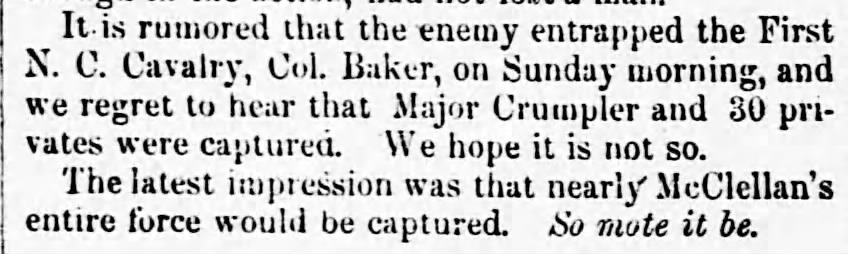
For days his family could not know what had happened. On 2 July the Weekly Standard in Raleigh could only report a rumour that he had been captured. He had not. He had been carried to a hospital in Richmond, and at first the doctors thought he might recover. An eyewitness diary, quoted in B. J. Alderman’s history of the fight, Ambush at Willis Church, says he was still conscious the next day. He died in Richmond on 11 July 1862. That is why the stone says he “fell” on 29 June: it is the day he was wounded, not the day he died.
“Most nobly has he redeemed his pledge”
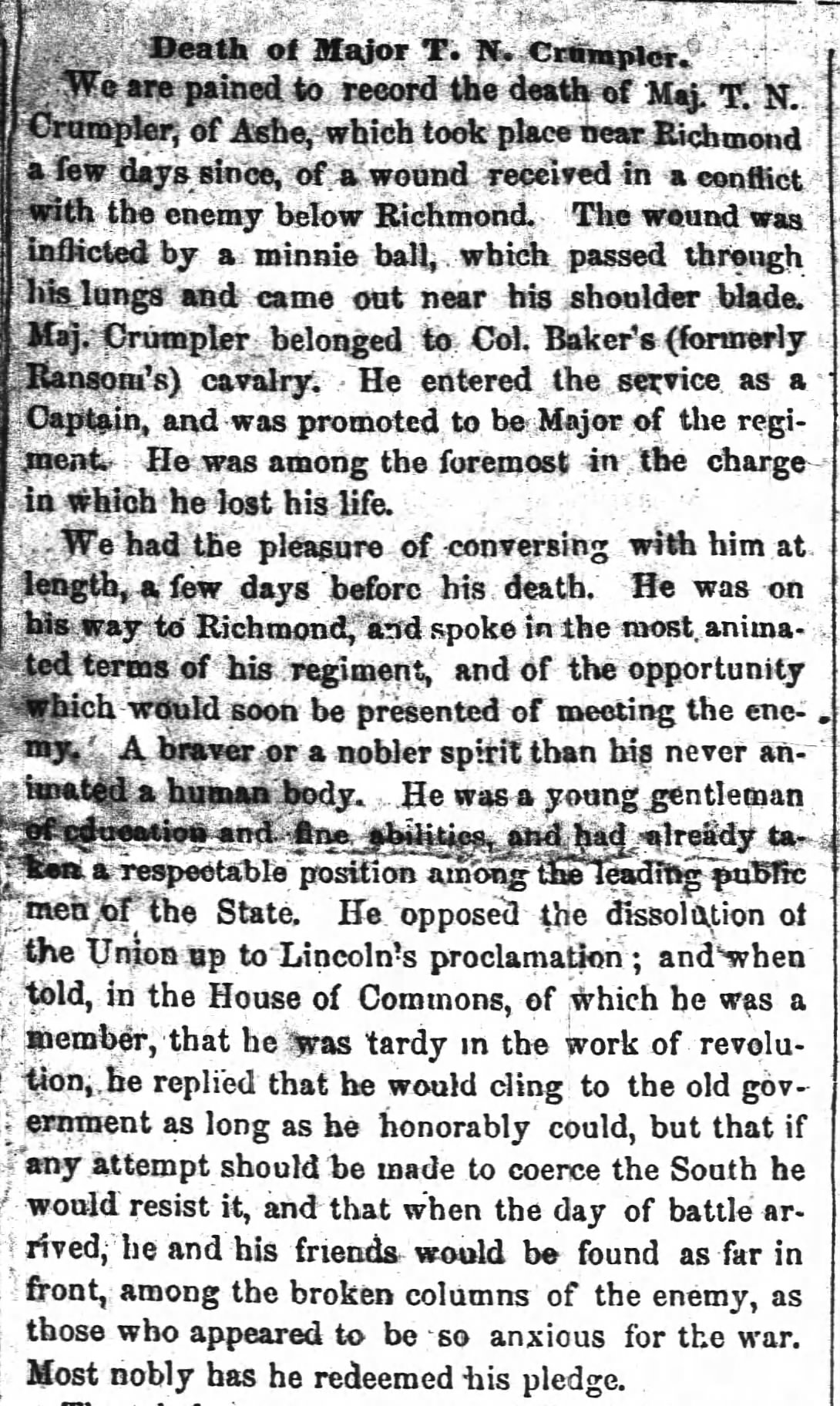
On 30 July the Weekly Standard printed his obituary. The editor had talked with him at length only days before the battle, and he remembered the speech. When Crumpler was taunted in the House with being “tardy in the work of revolution”, he had answered that he would cling to the old government as long as he honourably could, but that if the South were coerced he would resist, and when the day of battle came he and his friends would be found as far in front as those who seemed so anxious for war. He “was among the foremost in the charge in which he lost his life.” The notice ends with a single line:
“Most nobly has he redeemed his pledge.”
The Standard was W. W. Holden’s paper, and Holden too had been a Unionist until Lincoln’s call for troops.
Home to Rockford
His body was brought home to Surry County and buried at what is now Rockford Baptist Church Cemetery, near the Yadkin River. (A second Find a Grave memorial places him in Oakwood Cemetery, Richmond, probably his first resting place before he was taken home.)
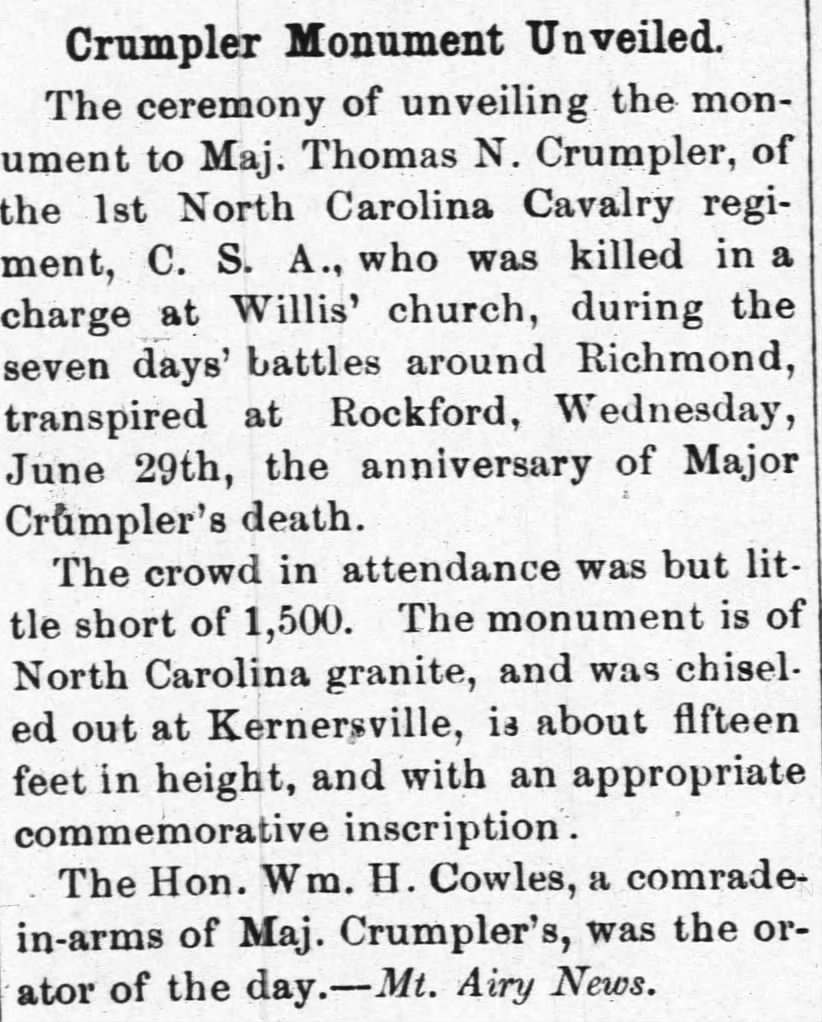
For twenty-four years the grave was unmarked. In late 1886 three of his old comrades, General Rufus Barringer of Charlotte, Lieutenant Colonel William H. H. Cowles, by then a congressman, and Captain Daniel P. Mast of Winston, appealed for funds and bought the granite shaft. The unveiling, first planned for 10 May 1887, was moved to 29 June, the twenty-fifth anniversary of the charge. The Mount Airy News counted a crowd “but little short of 1,500”; other reports said fully two thousand. A band came from Mount Airy, and Cowles, who had served with him, spoke for two hours on his life and character.
There is one more memorial. In 1885 a new post office opened in the Healing Springs area of Ashe County, in J. C. Plummer’s home, and it was named Crumpler in his honour. The community of Crumpler, North Carolina, still carries his name.
What to make of him
Thomas Crumpler was not a simple hero, and the people who knew him did not think he was a simple man. He defended slavery while fighting secession. He kept his word to the men who called him a laggard, and rode to his death keeping it. In the same winter he would not extend to his Jewish neighbours the right to hold office, and one of them answered him with more dignity than the debate deserved, and with a promise to defend the same state. Both pledges were made in North Carolina in the first months of 1861. The family can be proud of the first, and honest about the second.
Sources
- The Western Sentinel (Winston), 18 January 1861, p. 2: House of Commons proceedings, the vote on the arms bill.
- T. N. Crumpler, Speech of T. N. Crumpler, of Ashe, on Federal Relations, Delivered in the House of Commons, January 10, 1861 (Raleigh: Register office, 1861). Documenting the American South.
- The Weekly Standard (Raleigh), 27 February 1861, p. 4: House of Commons proceedings on the religious test.
- The Semi-Weekly State Journal (Raleigh), 27 February 1861, p. 3: Crumpler’s remarks on the Jews.
- The Charlotte Democrat, 12 March 1861, p. 3, “The Jewish Disability Bill” and the letter from “One of the Reviled” (first printed in the Charlotte Bulletin; also in the Wilmington Daily Journal, 8 March, and the Semi-Weekly State Journal, 20 March 1861).
- The Raleigh Register, 3 August 1861, p. 3, “A Splendid Troop of Cavalry.”
- The Weekly Standard (Raleigh), 2 July 1862, p. 2, and 30 July 1862, p. 1, “Death of Major T. N. Crumpler.”
- The People’s Press (Winston-Salem), 7 July 1887, p. 3, “Crumpler Monument Unveiled,” from the Mount Airy News.
- B. J. Alderman, Ambush at Willis Church, pp. 43–47 (eyewitness diary of his last days).
- Garth Matthews, History of American Crumplers (family background, education and career, the monument committee).
- Ashe County Historical Society, “Standing Against the Storm: The Life of Thomas N. Crumpler” (the Crumpler post office). It gives his death as 30 June at Glendale; the 1862 newspapers and the diary show he was wounded on 29 June and died on 11 July.
- Find a Grave memorial 102904432, Rockford Baptist Church Cemetery; monument photograph by Kathy Merris Mills, 2013.
His birth year: the monument says 22 February 1831; Garth’s history gives 1832. The newspaper images above, and the full record of Major Crumpler’s life and family, are on his page in the family tree. Corrections and additions are welcome through our contact form.