The Lordship of Lucies
How a Hertfordshire manor, a disgraced courtier of Edward VIII, and a bureau de change in the West End combined to make two people in Hawaii the Lord and Lady of Lucies.
On 22 March 1993 a letter went out from an auction house at 104 Kennington Road, London SE11. It was addressed to Craig W. Walsh Esq. of Whitecroft, Colletts Green, Worcester, and it was four sentences long before it got to the point:
Many thanks for your telephone call, and we confirm that your offer of £5,250.00 has been accepted on the above Lordship.
The above Lordship was Lucies, in Hertfordshire. The credit card was charged £1,749.14 that day — a twenty per cent deposit of £1,050, a buyer's premium of ten per cent plus VAT at £616.87, fifteen pounds for the catalogue, and £67.27 for the privilege of paying by card. Completion followed that August.
What follows is what we bought, who we bought it from, and — since the question always comes up — what a thing like this actually is.
IThe manor
The Victoria History of the County of Hertford puts the beginning of it plainly enough:
The manor of GADDESDEN or LUCIES was held of the manor of Little Gaddesden in the thirteenth century by the family of Lucy.
The Lucys came into it by marriage. Early in that century Geoffrey de Lucy married Juliana, daughter and co-heir of Ralph de Broc, and a large part of the family's property came with her. By about 1200 a Geoffrey de Lucy held one knight's fee in Berkhamsted, one in Slapton, half a fee in Byfleet, one at Hailes in Gloucestershire and one at Newenton in Kent. By around 1380 a Geoffrey de Lucy held a moiety of Gaddesden Parva of the Rector of Ashridge, together with the manor of Wigginton, a sixth part of Luton, the manor of Coventone, and rights of free warren in Gaddesden and eight other manors.
In 1444 Sir Reginald de Lucy held 102 acres of land and 33s. 4d. rent in Gaddesden Parva by the service of a fourth part of a knight's fee — that is, by giving ten days' military service a year. William Lucy died on 10 July 1459, and the manor descended through the female line.
By Elizabethan times it was held by Sir Robert Dormer. In 1602 Dormer and his wife Elizabeth granted it to John and Robert Eames, who in 1606 joined with the Dormers in conveying it to Thomas, Lord Ellesmere, and his son John Egerton. From the Egertons it descended with Great Gaddesden, and it stayed in that family — as Earls of Bridgewater, then as Earls Brownlow — for the next three hundred and fifty years.
It is worth saying, because it is the thing people assume, that the Lucys almost certainly never lived at the house now called the Manor House at Little Gaddesden. The village historian Vicars Bell, who wrote the best account of the building, thought it "extremely improbable", and doubted whether any house of size stood on the spot before the present one was built. The manor and the manor house are two different things. We own one of them, and not the one with the roof.
IIWhy the fish
The de Lucy arms were gules, three lucies hauriant argent — three silver pike, upright, on a red field.
A lucy, or luce, is a pike. The word reaches English from the Latin lucius, applied to the pike because it was thought of as the wolf of the river. Arms of that kind — where the charge puns on the name — are called canting arms, and the de Lucy pike is among the best known in English heraldry. In the reign of Henry III, G. de Lucy bore three lucies; a roll from Edward II's time gives Sir Thomas de Lucy de azure crusule de argent a iij luys de argent.
So the manor is named for a family, the family is remembered for a fish, and the fish is a joke about the family's name that has outlasted everyone who found it funny. This matters again at the end.
IIIThe man
The seller was the estate of Peregrine Francis Adelbert Cust, sixth Baron Brownlow (27 April 1899 – 28 July 1978), and he is the most interesting person in this story by a distance.
The manor reached him by an unlovely route. The root of our title, and the oldest document in the file, is a disentailing assurance of 28 March 1863 between John William Spencer Brownlow Egerton, second Earl Brownlow, and one Frederick Iltid Nicholl of Carey Street. Among a great cascade of Hertfordshire, Buckinghamshire and Bedfordshire property it lists "the several Manors or Lordships or reputed Manors or Lordships of Ashridge Gaddesden cum Frithsden … and Little Gaddesden with Lucies".
The second Earl died without issue in February 1867. His brother Adelbert succeeded as third Earl and died, also without issue, in March 1921 — at which point the earldom and the viscountcy became extinct and the barony went sideways to a second cousin, Adelbert Salusbury Cockayne Cust, fifth Baron Brownlow. The third Earl's will directed that the Ashridge estates be sold, and sold they were: the contents auctioned in May 1923, the house bought as a gift to the Conservative Party, most of the park and woodland to the National Trust by 1925.
That is the hinge of the whole story. The land went. The lordship stayed. An assent dated 5 April 1933 vested in the sixth Baron "all other (if any) the Manors or Lordships freehold property and rent charges in lieu of Tithes formerly part of the Ashridge estate" — the residue, the paper, the things nobody had thought worth selling. Lucies was in that residue. The Manorial Society's Hertford county file records him as its owner in 1969.
By then Lord Brownlow had had a life.
In the 1930s he was a close friend and equerry to the Prince of Wales, and became Lord-in-Waiting when the Prince became King Edward VIII. Edward and Mrs Simpson spent many weekends at Belton, the Brownlow seat in Lincolnshire. When the abdication crisis broke in December 1936 it was Brownlow who drove Wallis Simpson out of England to the south of France, away from the press, spending the journey trying to persuade her to give up the idea of marrying the King. He tried to enlist Queen Mary's support. He was refused.
He got no thanks from either side. He declined to attend the Duke of Windsor's wedding in 1937, and the Windsors thereafter thought him disloyal. The other side was worse. He learned from the Court Circular that he had been replaced as Lord-in-Waiting; when he telephoned Buckingham Palace he was told his resignation had been accepted, though he had never tendered one. King George VI and Queen Elizabeth gave instructions that his name was never to appear in the Court Circular again.
He was Mayor of Grantham in 1934–35 and Lord Lieutenant of Lincolnshire from 1936 to 1950, served in the RAF Volunteer Reserve and was Parliamentary Private Secretary to Lord Beaverbrook. In the 1970s he owned a painting he maintained was a second Mona Lisa by Leonardo, and argued about it in public. He married three times. He died on 28 July 1978, and probate of his will was granted on 13 November that year to Arthur David Bowyer, Bernard Shipman and Richard Nevill Cannon.
Those three men, as his executors and trustees, are who we bought the Lordship of Lucies from, fifteen years later.
IVBuying it
The first document in our file is not a deed. It is a cutting from The Sunday Times of 14 March 1993, headed "To the manor bought", and it is not flattering:
Before you put a down-payment on an ermine-fringed robe and rush for a title, however, be warned. You get precious little in tangible terms and nothing like the perks — actual land, for instance — enjoyed by the original title-holder.
Eight days after that piece appeared, the offer went in. We had read the sceptical article and bought the thing anyway, which is the only honest way to do it.
The trade at the time was brisk and slightly desperate. The article describes landed families beset by Lloyd's losses, death duties, dry rot and insurance premiums, selling off "dusty and dispensable feudal titles" to pay the bills. Run-of-the-mill lordships went for about £4,000; most sat in the £5,000–£7,000 range. Ours was £5,250, squarely in the middle of the market.
The machinery was as follows. Manorial Auctioneers Ltd handled the sale. The seller's solicitors were Charles Russell; ours was Richard Sutton of Bailey Shaw & Gillett of 17 Queens Square, London WC1N 3AR. Because a lordship has no register and no land certificate, title is proved by statutory declaration — in this case sworn in May 1993 by Robert Alexander Smith BA, Chairman of the Manorial Society of Great Britain, who set out the descent in eleven numbered paragraphs and exhibited the 1863 indenture, the wills, the probates and the assent. Paragraph 10 is the one that matters:
my research has disclosed no adverse claim against the Executors and Trustees or their predecessors in title nor have I found any evidence of a conveyance of the Manor by the Executors and Trustees or their predecessors in title
Mr Sutton's covering letter of 26 May 1993 is admirably plain about what that establishes and what it does not:
The indenture transferred the title together with the benefit of any rights which went with the manor. However, the rights (if any) are not actually defined.
He had asked the seller's solicitors what rights those might be. They had not replied.
VWhat it is, and what it is not
Here is the distinction the whole business turns on, and it is a real one.
A peerage is a dignity. It is conferred by the Crown, it descends according to the letters patent that created it, and it is not property. It cannot be sold, mortgaged, or left to whoever you like. Lord Brownlow could not have sold his barony to anyone at any price.
A lordship of the manor is property. In law it is an incorporeal hereditament — a thing that can be owned and inherited but has no physical existence. Precisely because it is property it can be bought and sold, which is why it was on the market at all. The sixth Baron's trustees could not sell his barony. They could sell his manor, and did.
The two are therefore not different grades of the same thing. They are different kinds of thing altogether. A lordship of the manor carries no rank, no precedence, no seat in the House of Lords, no place in the peerage, and no form of address a peer would recognise. The correct style is Craig Walsh, Lord of the Manor of Lucies. It is emphatically not Lord Lucies, and anyone who tells you otherwise is selling something.
What the lord of a manor once had was jurisdiction and revenue: the court baron for disputes between tenants, the court leet for petty crime, chief rents, rights over the waste and commons, sometimes a market or a fair by royal charter, sometimes free warren, minerals, sporting rights. Those were real. They were also almost entirely dismantled by statute. The Law of Property Act 1922 abolished copyhold tenure with effect from 1926, and with it went the reason most manorial machinery existed. What survives is a chain of title to an office with nothing left to do.
The paperwork has been wound down too. HM Land Registry stopped accepting new registrations of manorial lordships on 13 October 2003, so a lordship today is a purely private conveyancing matter, proved — as ours is — by declaration and a bundle of copies.
What you do get is a style and a piece of paper. The Manorial Society offered members a letter of confirmation "for those Members who wish to use their Manorial style inside passports, driving licences, and other official documentation", which is about the measure of it.
None of which makes it fake. The 1863 indenture is a real deed. The 1933 assent is a real assent. The descent from the de Lucys through the Dormers, the Eameses and the Egertons to the Custs is a matter of record, and the Victoria County History has it in print. We really are the Lord and Lady of Lucies, in exactly the way that someone who buys a field really owns a field. It is simply that this particular field has been under water since 1926.
VIA fright, in 2008
Fifteen years later Craig was building a website about all this — lordoflucies.com — and doing the sort of idle Googling that leads nowhere good. He found the sites that warn about fake titles, on several of which Robert Smith of the Manorial Society is quoted as the authority. Then he found something worse. On the Society's own site was a notice of a Manorial Auctioneers sale held on 20 May 2008 at Stationers' Hall, "on the instructions of a Crown Charity, aristocracy, and others". Among the lots was The Lordship of Little Gaddesden, Hertfordshire.
He telephoned that morning and faxed the same day.
Can you, therefore, please provide me with further details on the instructing party in the proposed sale of the Lordship of Little Gaddesden? Who is trying to sell something that we already own?
The reply came back by fax that afternoon, and it is the clearest short statement of what a manor is that anyone has ever given us:
The Brownlow Estate sold you the Lordship of the Manor of Lucies, in the parish of Little Gaddesden. The Estate sold the Lordship of Little Gaddesden in 1991 as also, in the same parish, the Lordship of Ashridge. The vast majority of parishes in the country are divided into at least two manors, and the sale of one does not operate to convey the other, any more than, say, your owning two adjacent fields and conveying one, which conveyance does not convey the other.
So the parish of Little Gaddesden holds at least three lordships — Ashridge, Little Gaddesden, and Lucies — and the Brownlow trustees sold them off separately: Little Gaddesden in 1991, Lucies to us in 1993. The 1863 indenture had listed them in one breath, and they had been in the same hands for three centuries, but they were never one thing. A manor is a unit of lordship, not a place on a map. Two can sit in the same parish and belong to different people, as ours do.
The Lordship of Little Gaddesden was withdrawn from the 2008 sale in any event, Smith added, "for legal reasons, completely unconnected with the Lordship of the Manor of Lucies". He did not say what they were.
VIIHow we came to know Interbrand
This is a detour, but the coat of arms does not make sense without it.
In November 1986 we launched a cheque guarantee service. British banks would then guarantee a cheque only up to a miserly fifty pounds, which had handed the credit card companies the entire high street; our service guaranteed personal and business cheques up to a pre-arranged store limit, authorised by a free telephone call, and reimbursed the retailer in full if the cheque bounced. We called it Cheque Point Guarantee Limited. The name had been suggested by our advertising agency, who had dutifully checked it at Companies House.
Shortly after the London press launch a letter arrived from solicitors acting for Chequepoint Bureau de Change, claiming prior rights in the name and threatening an action for passing off. Not being Londoners, we had never heard of their chain of bureaux de change, which was largely confined to the West End.
We fought it. The two services had nothing in common — they changed foreign currency, we indemnified retailers taking sterling cheques — and it seemed to us that there was very little there to pass off as. To prove the point we commissioned MORI to stop customers as they came out of a Chequepoint bureau and ask them the name of the bureau they had just used. Only a small minority could say.
On the second day of the hearing the judge let slip that he still did not understand that one could cash a cheque at a bureau de change, and called a recess. During it the other side offered terms: change the name within six months. We were a tiny company facing an opponent of unknown size and a case that could run for a year, and we took it, with considerable reluctance.
That left six months to find a new name and put it on the stationery, the brochures, the business forms and several thousand shop windows. So we went to Interbrand.
Interbrand ran brainstorming groups of what Tom Blackett called "imaginative wordsmiths", passed the output to copywriters, ran it through the firm's own name-creation software, screened the survivors through Markforce Associates — the group's trade mark legal consultancy — and presented us with fifty names. Among them were Assent, rejected as too close to Access; Countercheck and Cheqtel, rejected as redolent of the past; Quicksilver; and Transax. A search of Class 36 of the UK Trade Mark Register took a fortnight and Transax came through clean.
Then the logo. Interbrand's designers produced concepts that differed only in the treatment of the straight lines around the name, which sounds trivial and is not. Fine lines left the name floating and unreassuring; heavy ruled lines were rigid. The version chosen used hand-drawn lines, on the reasoning that a service asking to check a stranger's creditworthiness at the till needs to look human. Blackett's write-up puts it well: the chosen mark was "less contrived than the others and more the product of thinking, breathing human beings."
Implementation involved persuading thousands of retailers to scrape a heavily gummed decal off the window. Transax ended up offering a pound to charity for every Cheque Point sticker returned.
It worked. By the 1990 financial year Transax guaranteed 5.3 million cheques worth more than £700 million a year across some 34,600 retail outlets — Next, Saxone, Austin Reed, Halfords, Ratners — and was the largest cheque guarantee company in the world outside the United States. Blackett's verdict was that we had been lucky to have disaster strike early, while there was still time to start again.
He wrote the episode up in 1991 as "Developing a New Brand — the 'Transax' Story", and it became Chapter 6, "Case History: The 'Transax' Story", of his book Trademarks (Macmillan Business, 1998). The typescript is in our files, along with the letter of 8 November 1991 in which he thanks Craig for approving the draft, and Marjorie's memo giving her verdict first: "I've read the piece by Tom Blackett. I like the writing style — it's readable and informative and tells a good story."
We sold Transax in 1996, having owned it for ten years almost to the month.
VIIIThe arms
Which brings us back to Hertfordshire, and to the last document in the file.
On 6 August 1993, writing to Robert Smith to say that completion was expected the following week, Craig added:
As a Coat of Arms sounds like fun, I'll contact The Institute of Heraldic and Genealogical Studies. Do they design the Coat of Arms or is this done elsewhere?
The strict answer is that in England and Wales nobody designs your arms but the Kings of Arms at the College of Arms, who grant them by letters patent under authority delegated from the Crown — and that arms are granted to a person, not attached to a manor. Buying a lordship gives you no more right to a coat of arms than buying a house does.
The agency the Manorial Society pointed us to did produce a design. It was boring. They also told us that they were the only people who could submit arms for approval, which was not true — a petition, or memorial, goes to the Earl Marshal drafted by one of the officers of arms at the College, and anyone may approach a herald directly. What the agency was selling was an introduction.
So we did not get a grant. We went back to Interbrand, who by then knew us rather well, and asked them to design one instead. No correspondence about it survives: when Transax was sold in 1996 the files went with the company, and what we kept were copies of the Directors' Office papers. The arms themselves survive, and they are a better record than a letter would have been.
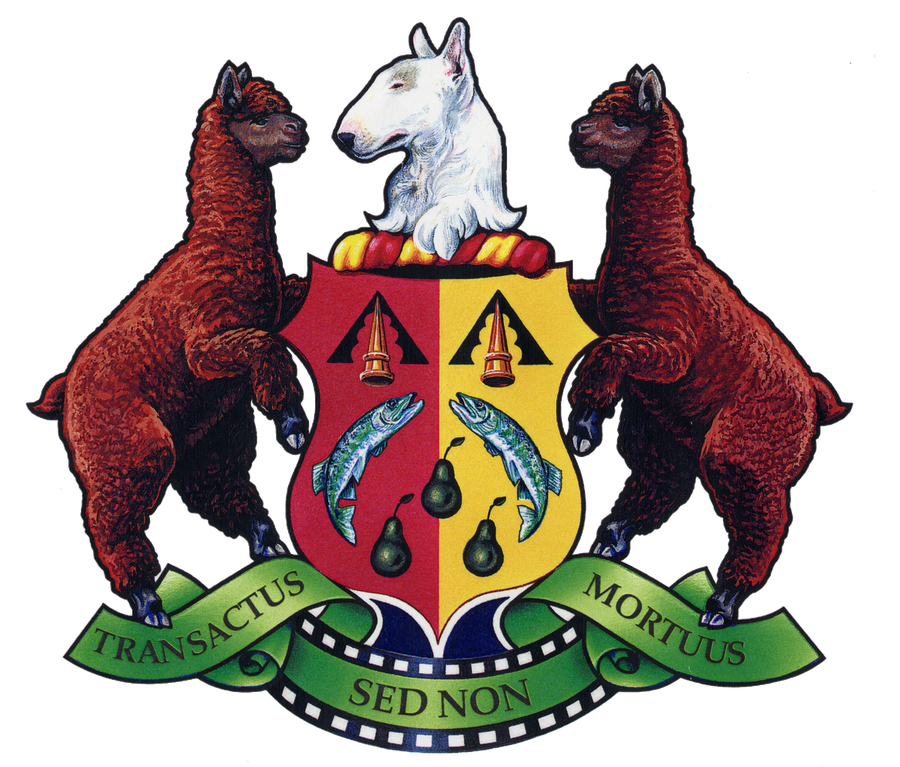
The field is party per pale, red and gold — the Transax colours. The logo Interbrand had drawn for us was grey, with one yellow line and one red line; the shield simply takes the two colours and gives each a half.
On and around it:
- Two fish. Lucies. Pike. The de Lucy joke, made in about 1250, still running.
- Two black broad arrowheads, points upward. These come straight off the Walsh arms — argent, a chevron gules between three broad arrow heads, points upwards sable — and they are reproduced almost exactly: the same barbed triangle with scalloped inner edges, the same spike down the centre, though Interbrand drew the spike in gold and in three dimensions rather than flat. Walsh has three of them, two above the chevron and one below; Lucies has two, one to each half of the divided field.
- Pears, for Marjorie, who is a Malvern girl, born and raised in Worcestershire.
- The crest is the head of a bull terrier, which needs no explanation to anyone who has met the family.
- The supporters are two alpacas, rampant, for the farm.
- Beneath the shield runs a single green ribbon — and where it dips through the centre it becomes a strip of motion picture film, sprocket holes down both edges, for two people who love making them.
- And the motto: TRANSACTUS SED NON MORTUUS.
That motto is the cleverest thing on the shield, and it is not really ours. The Walsh motto is TRANSFIXUS SED NON MORTUUS — transfixed, but not dead — and it goes with the Walsh crest, which is a swan pierced through the back and breast with a dart, still alive. Interbrand changed one word. Transfixus became transactus, and a medieval Irish boast about surviving an arrow became a pun on the name they had invented for us in 1987 to survive a firm of London solicitors.
One last thing about that ribbon. It carries TRANSACTUS on the left and MORTUUS on the right as plain green scroll, and it turns into film for exactly two words in the middle: SED NON. The design becomes cinema precisely on the negation — the but not that keeps the swan alive.
And the swan is worth one last story. Craig's father once ordered an Irish linen hand towel embroidered with the Walsh arms. Months later it arrived, bearing what appeared to be a duck, with an arrow through its heart.
Could we still submit them?
The thought is irresistible, so we looked into it. We could. Anyone may petition, the memorial goes to the Earl Marshal through a herald, and there are no fixed criteria of eligibility — degrees, professional qualifications, public and charitable service and "eminence or good standing in national or local life" are all weighed. As of 1 January 2026 the fee for a personal grant of arms and crest is £9,600.
There are two catches. The first is that you do not submit a design; the College designs your arms, and while the heralds will listen, they decide. Most of ours would survive that — the pike especially, since canting arms are exactly what heraldry likes.
The second catch is the alpacas.
Supporters — the beasts that stand either side of a shield and hold it up — are in England restricted to peers, Knights of the Garter, Knights Grand Cross, and certain corporate bodies. A private gentleman does not get them, and no quantity of manors alters that, because a lordship of the manor is not a peerage. It is the distinction this whole article is about, and it lands on the one element of Interbrand's design that looks most aristocratic.
Which makes the proposition: nine thousand six hundred pounds, to be told to take the alpacas off.
We will keep the alpacas. And since a motto forms no part of an English grant anyway, TRANSACTUS SED NON MORTUUS on a strip of motion picture film is ours to keep whatever anybody says.
Transfixed, but not dead. It is also, read against everything above, a fair description of a manor that was disentailed in 1863, orphaned from its land in 1925, stripped of its function in 1926, closed out of the Land Register in 2003, and is still, demonstrably, here.
Sources: the Lord of Lucies title documents (125 pp., 1863–1993), including the disentailing assurance of 28 March 1863 and the statutory declaration of Robert Alexander Smith of 15 May 1993; the Transax/Interbrand correspondence file (1990–1991), including Tom Blackett's typescript "Developing a New Brand — the 'Transax' Story", published as chapter 6 of his Trademarks (Macmillan Business, 1998); the Manorial Society correspondence of 4 June 2008; the Victoria History of the County of Hertford, vol. II; Vicars Bell on the Manor House at Little Gaddesden; The Sunday Times, 14 March 1993.